Resident Card Resources: Good News!
Resident card resources are a decisive condition for obtaining the card. In a recent decision dated August 3, 2026, the Conseil d’État (Council of State) just provided a crucial clarification that could unblock many applications. I will decipher this essential case law for your future resident card applications.
As a reminder, Article L. 426-17 of the Code on Entry and Residence of Foreigners and Right of Asylum (CESEDA) sets strict conditions for the issuance of this 10-year card. The applicant must notably justify:
-
Regular and uninterrupted residence of at least 5 years in France;
-
Health insurance;
-
Stable, regular, and sufficient resources to support themselves.
The law specifies that resident card resources must be at least equal to the SMIC (French minimum wage), excluding family benefits and certain allowances.
Until now, many prefectures interpreted this text extremely restrictively, refusing residence permits to foreigners who had not earned the equivalent of the SMIC every month over the past 5 years.
The Conseil d’État ruled on this precise point on August 3, 2026.
The high administrative court specifies that 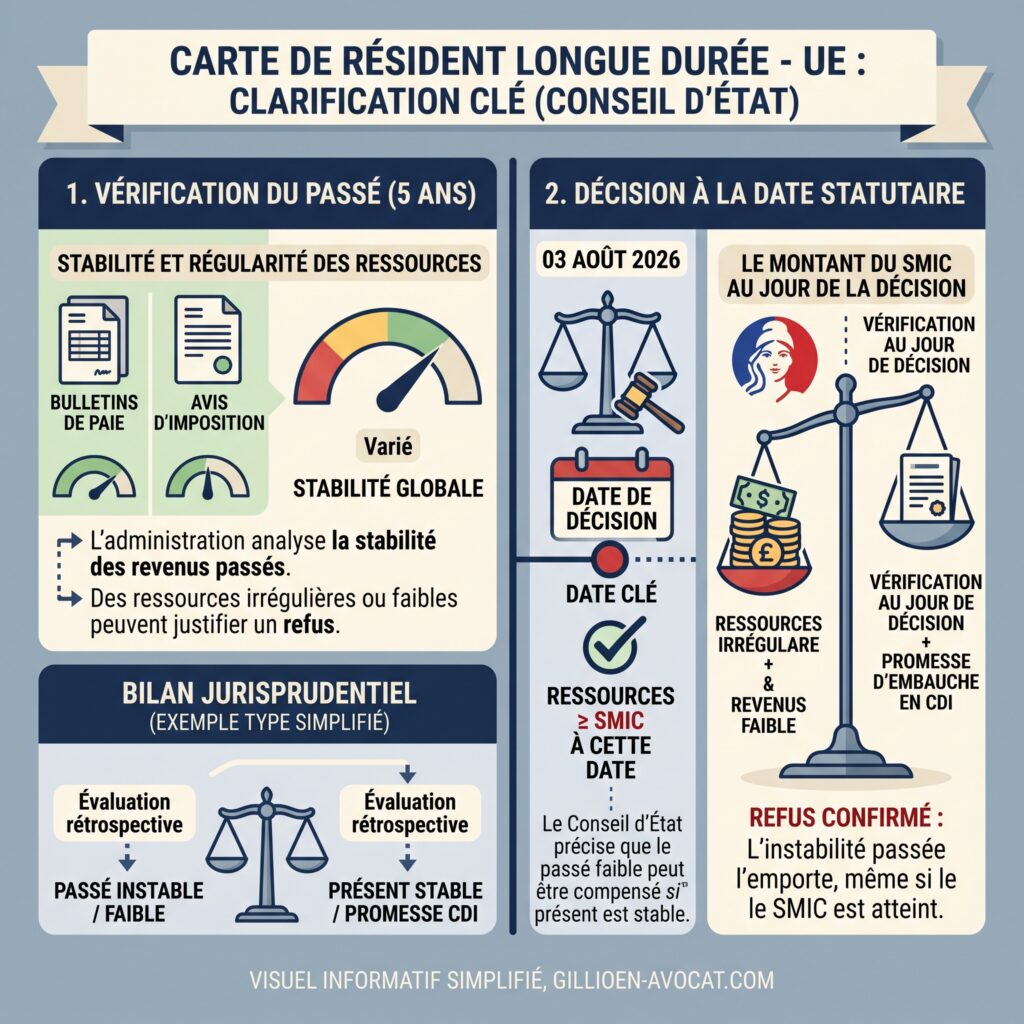 are assessed only as of the date on which the administration (the prefecture) rules on the application.
In other words, the provisions of CESEDA “do not require that the applicant has disposed of, over the previous period under consideration, resources equal to that same amount.”
It is therefore perfectly possible to obtain this 10-year resident card if you earn the SMIC today, even if you experienced periods of unemployment, part-time work, or income below the SMIC during the previous 5 years.
This is clearly a positive decision.
Beware of false hopes, however: if the SMIC amount is not required over 5 years, the regularity and stability of your income still are.
The administration is entitled to look back over the past 5 years to study the evolution of your income (via your pay slips, tax notices, etc., as provided by item 58 of annex 10 of CESEDA). These documents serve to verify that you are not too precarious a worker, without demanding that the SMIC threshold be met retroactively.
As proof, in the case judged on August 3, 2026, the Conseil d’État still validated the prefecture’s refusal: although the applicant presented a recent offer of permanent employment (CDI), the resident card resources over the preceding 5 years were far too irregular and low to guarantee the famous “stability” required by law.
This Conseil d’État decision is excellent news for foreign nationals whose professional career has been evolving. It formally prohibits prefectures from issuing an automatic refusal solely because the SMIC was not earned continuously over 60 months.
However, it reminds us that the preparation of the application file is meticulous. One must know how to demonstrate to the administration a genuine dynamic of professional integration and global financial stability.
Was your resident card application refused on grounds of insufficient resources? Do you wish to submit a solid application to stack the odds in your favor?
We assist you, analyze the history of your resources, and defend your rights against the administration or before the administrative courts.
To learn more about the author, discover the biography of Alexandre Gillioen, immigration lawyer in Lyon
Next post: New Citizen's Handbook for the Assimilation Interview in Naturalization by Decree