The Instruction of April 5 2026 relative to the lapse of rights
The Instruction of April 5 2026 from the Minister of the Interior is titled: “Instruction relative to the reinforcement of the strategy regarding the reduction of processing times for residence permit applications and the fight against the lapse of rights”. The purpose of the Instruction is to focus the attention of the relevant administrative authorities (prefectures) on processing delays and the lapses of rights.
First, this reaction from the administration should be welcomed. Admittedly, the Instruction is only an instruction and has no binding legal value (unlike a law, for example). But the Instruction of April 2026 demonstrates that the situation regarding the lapse of rights is now serious enough for the primary political official (the Minister of the Interior) to decide to act. We can therefore see it as a positive sign, even if it remains to be seen whether the Instruction of April 5, 2026 will be followed by actual effects on the ground.
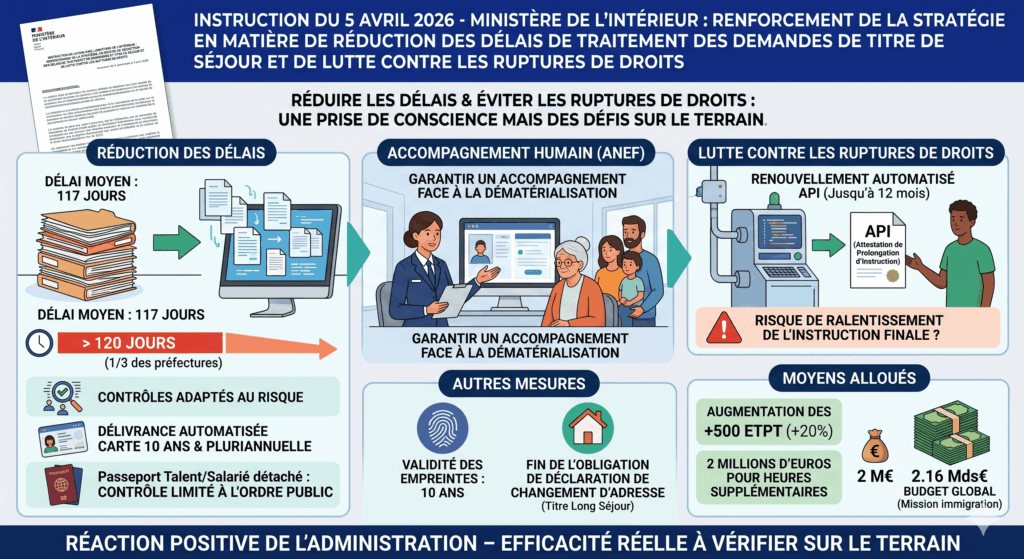
The first part targets application processing times. It provides the following figures: an average delay of 117 days for issuing a permit (this is an average across all types of residence permits and all prefectures). Furthermore, it specifies that this delay exceeds 120 days for one-third of prefectures. We know that in practice, delays can often exceed a full year in certain cases.
It outlines several points intended to improve these timelines:
- Prefectures must adapt the level of control based on fraud risks and permit categories.
- The examination of “talent” or “ICT seconded employee” cards must now be limited solely to public order concerns.
- The issuance of 10-year or multi-year cards must be automated as soon as the substantive conditions are met.
- Better human support “must be guaranteed for the most vulnerable populations” facing digital transition (ANEF) according to the Instruction of April 5, 2026.
All of this seems to stem from simple common sense. In reality, it is obvious that an increased number of checks slows down application reviews; if these can be removed or reduced as suggested by the Instruction of April 5, 2026, processing will be faster. The “talent passport” is a prime example: a person who has already obtained their long-stay visa should not have to wait four additional months, as the conditions have already been verified by consular authorities.
The second part of deals with the lapse of rights, a major issue in 2025 and 2026. To this end, the Instruction of April plans that the renewal of certificates of extension of processing (API) will be automated (up to 12 months) to prevent lapses of rights. However, might it not risk slowing down the final processing of files? Previously, the lack of an “automatic” API tended to push foreign nationals to follow up. If they are granted an API more “easily”, the case file review could last even longer.
Two other elements from the Instruction of April 5, 2026 are also noteworthy:
- The validity period for biometric fingerprints is increased from 5 to 10 years.
- The Instruction of April 5, 2026 also removes the obligation to declare a change of address for holders of long-term permits.
Finally, it announces a 20% increase in staff and 2 million euros to fund overtime. This amount seems extremely low compared to the total volume of this mission in the budget law: 2.16 billion euros, or approximately 0.093% of the total amount.
In summary, while the intent should be lauded as it shows the Ministry of the Interior is aware of the problem, it remains to be seen what real-world effectiveness it will have.
To learn more about the author, discover the biography of Alexandre Gillioen, immigration lawyer in Lyon
Previous post: Conseil d'État: The Important Decision of May 5, 2026 on ANEF - Next post: 2025 Immigration Figures: What Do They Tell Us?