2025 Immigration Figures: What Do They Tell Us?
The 2025 immigration figures were released in January, as they are every year. And, as happens every year, everyone (especially the media and far-right politicians) finds in them whatever suits their agenda. The way the administration itself presents these facts speaks volumes.
Indeed, the first thing to note is that the number of first-time residence permits issued has increased by 11%, a rise attributed entirely to the increase in the number of individuals granted subsidiary protection. Once again, there is an attempt to push an image of “involuntary” immigration, which is framed as inherently negative.
However, on this subject (which is not my primary concern), what remains unsaid is that Ukrainians account for 40% of first-time residence permits issued on humanitarian grounds. If it were phrased that way, the public’s reaction would be quite different from the one intended.
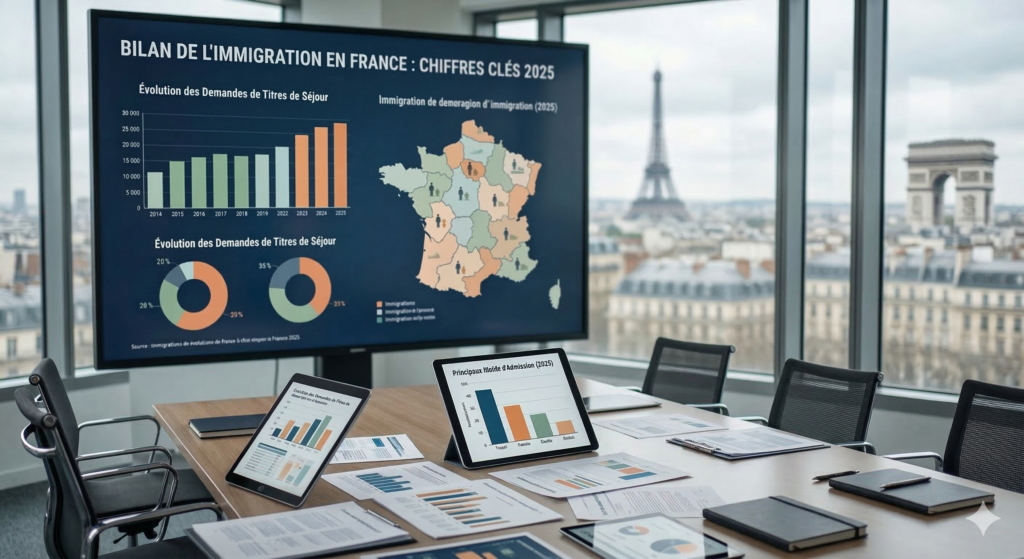
Beyond this dishonest presentation, it should also be noted that the focus is placed on first-time permits (384,000), while 955,000 permits were renewed during the same year—nearly three times as many. These renewals include permits for economic and family reasons. For instance, student residence permits alone accounted for 151,690 renewals in 2025, according to the official figures.
Naturally, these represent permits that expired in 2025. Others will expire later, given the high number of multi-year permits currently in use.
Regarding nationalities—and contrary to a deeply entrenched but false narrative—African nationals renew more residence permits for economic reasons than others. Overall, 2025 was a standard year in this regard, with no specific anomalies compared to what we have seen in the past. Nonetheless, other insights from the 2025 data are worth noting.
The number of “Talent” residence permits increased by 4%, which is positive. This growth is driven (at 18%) by “self-employed workers,” i.e., foreign business creators. This is good news as it shows that, despite a complex system, France still attracts foreign entrepreneurs with capital. In total, “Talent” permits represented 47,340 in 2025 (excluding family members).
In 2025, the number of regularizations decreased by nearly 10%, which is significant. While the narrative highlights the high number of humanitarian permits issued, a five-line paragraph hides the fact that regularizations have suffered a drastic drop. This decline is mainly for economic reasons (-11%). The decrease is less pronounced for family-based regularizations, but only because undocumented foreigners marrying French citizens are included in this category.
Finally, while the number of foreigners is estimated at around 4.5 million, this figure only includes non-EU foreigners. EU nationals, who are very numerous, are not included in this total, even though they are also foreigners.
Nearly 2 million of these 4.5 million foreigners hold resident cards—10-year permits that authorize them to live in France long-term.
The 2025 immigration figures teach us that while the number of foreigners in France continues to evolve, this growth remains fairly constant compared to previous years. Similarly, there is absolutely no “overwhelming” of France by foreigners, as the number of undocumented foreigners who were regularized has actually decreased by more than 10%.
To learn more about the author, discover the biography of Alexandre Gillioen, immigration lawyer in Lyon
Previous post: The Instruction of April 5 2026 relative to the lapse of rights - Next post: 2026 immigration law: What Can We Expect This Year?