Foreign Students in France: Required Minimum Resources Set to Rise Sharply From August 1, 2026
Starting August 1, 2026, the required minimum resources foreign students will be significantly higher than the level of monthly income than today. This follows a decree published in the Official Journal on June 24, 2026, which fundamentally overhauls how this threshold is calculated.
A Completely Revised Calculation Method
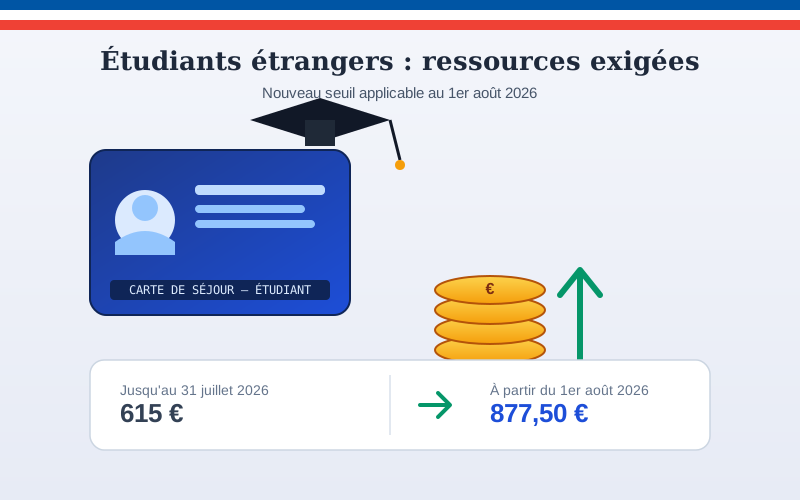
Until now, foreign students had to show they had monthly resources at least equal to the basic monthly maintenance allowance paid to French government scholarship holders — that is, €615 per month. The problem: this reference amount had barely changed since the early 2000s, making it increasingly out of step with the actual cost of living.
The new text changes the logic entirely: the resource threshold will now be indexed to the gross monthly minimum wage (Smic) rather than to the old allowance. Concretely, students will have to prove resources equal to at least 47% of the gross monthly Smic in effect on the date their application is filed.
Based on the gross Smic applicable since June 1, 2026 (€1,867.02), this new threshold amounts to €877.50 per month — nearly 43% more than the previous €615 figure.
The 47% rate was not chosen at random: expressed as a share of the net Smic, it corresponds to 60% of the Smic, which is exactly the cap on part-time paid work that a foreign student is legally allowed to carry out alongside their studies. The idea, then, is to align the required resource threshold with the income a student could earn from a student job carried out within the legally authorized limit.
Another new feature: this threshold will no longer be fixed over time. It will be reassessed at least once a year by ministerial order and will track inflation, preventing it from once again drifting away from economic reality as happened with the old reference index.
Who Is Affected?
This required minimum resources foreign students France applies to all third-country nationals applying for:
- a temporary residence permit bearing the “student” designation;
- a temporary or multi-year “student–mobility programme” residence permit;
- or those staying in France, for a maximum of 12 months, under a mobility programme after having been granted residence in another European Union member state.
The new threshold will apply to all applications filed from August 1, 2026 onward, whether for a first-time permit or a renewal.
Why This Tightening?
This change follows a March 2025 report by France’s Court of Auditors (Cour des comptes) on the attractiveness of French higher education for international students. The auditors highlighted two issues: a resource threshold deemed too low to guarantee genuinely sufficient means of subsistence, and a reference index considered insufficiently relevant and adaptable to serve that purpose.
The government therefore chose to anchor this threshold to a more robust, automatically updated economic indicator — the Smic — rather than to a fixed amount set by ministerial order that had remained unchanged for over twenty years.
Key Takeaways
- Before August 1, 2026: required minimum resources foreign students France = €615 per month.
- From August 1, 2026: required minimum resources foreign students France = 47% of the gross monthly Smic, i.e. €877.50 as of June 1, 2026.
- This threshold will be revised annually in line with inflation.
- The reference text is Decree No. 2026-526 of June 22, 2026, published in the Official Journal on June 24, 2026, which inserts a new Article R. 422-2 into the French Code on the Entry and Residence of Foreign Nationals and the Right to Asylum (Ceseda) and repeals the last paragraph of Article R. 422-8.
Prospective applicants for studies in France will therefore need to anticipate this significant increase when putting together their residence permit application, particularly with regard to proof of scholarship, bank transfers, or sponsorship/financial support certificates.
To learn more about the author, discover the biography of Alexandre Gillioen, immigration lawyer in Lyon
Previous post: New Citizen's Handbook for the Assimilation Interview in Naturalization by Decree - Next post: Refusal of an Employee Visa: How to Challenge it Before the Administrative Court