Oral visa refusal: the Administrative Court of Nantes suspends a registration refusal issued by TLS Contact
Oral visa refusal: an agent of a private company examines your file, then tells you, without writing anything down, that they will not register it. No letter, no reasons given, no indication of available remedies. You have just suffered an oral visa refusal.
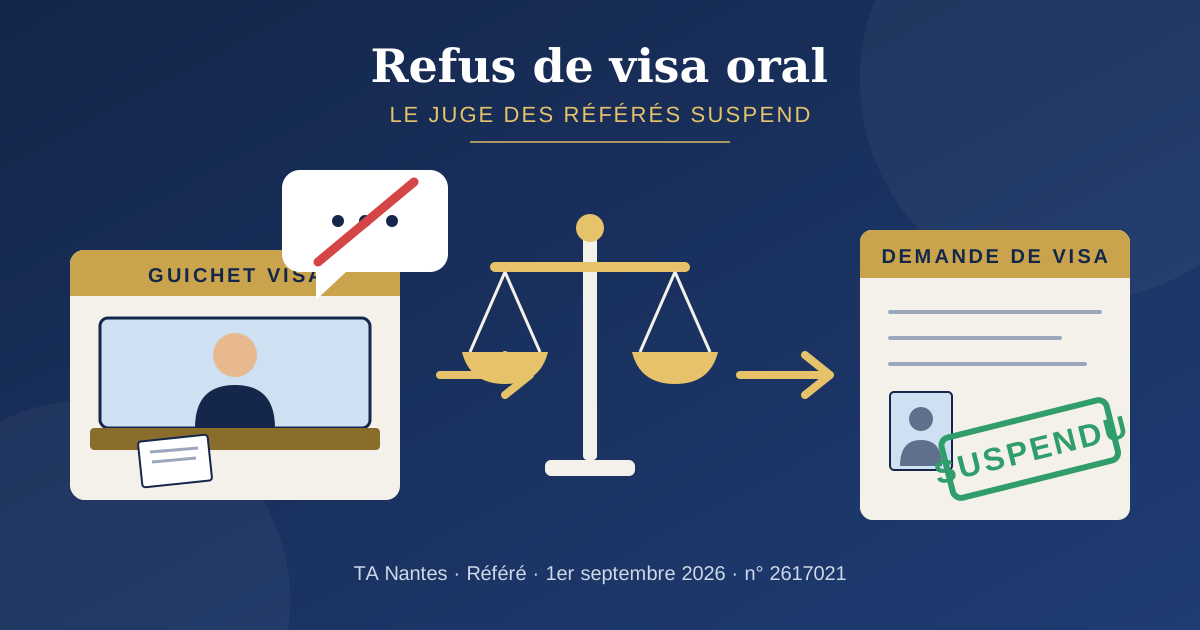
This situation, which many applicants know, has just been the subject of a remarkable decision: by an order of 1 September 2026 (no. 2617021), the urgent applications judge of the Administrative Court of Nantes suspended the oral visa refusal issued by an external service provider on behalf of the French consulate in Cairo.
The applicant is a Palestinian national who left the Gaza Strip in February 2024 and has since been living in Egypt in an irregular situation. She wishes to travel to France to marry a French national, with the wedding scheduled in Rennes on 30 October 2026 (the banns were published on 13 May 2026).
On 5 July 2026, she went to TLS Contact, the provider that receives visa applications on behalf of the French consulate in Cairo, in order to submit a short-stay visa application. The provider verbally refused to register her application, on the grounds that she did not hold a residence permit in Egypt.
As a result, her application was never forwarded to the consulate and therefore could not be examined at all.
She therefore applied to the urgent applications judge against this oral visa refusal.
It is notable that a purely verbal decision can be challenged before a judge: the absence of a written record does not prevent the existence of a decision adversely affecting the applicant, nor its judicial review.
The judge notes that the contested decision has the effect of preventing the consular authority from examining the application at all.
The judge accepts one interesting ground as capable of creating serious doubt: the lack of competence of the author of the act. The decision was taken by a service provider, and not by the consular authority.
A service provider is not a consulate. Centres such as TLS Contact or VFS Global receive files, check that they are complete and collect biometric data. The decision to grant or refuse a visa belongs to the administration. The order goes in the direction of a review of what a private provider can, or cannot, decide.
This is the first time an administrative judge has recognised this. And given the practices observed among the various private companies, this is an excellent thing.
Next, an oral visa refusal is not a visa refusal, but it has the same effects. As long as the application is not registered, it is not examined, and the applicant receives no written decision that can be challenged through the usual appeal routes. The urgent applications judge agrees here to review its legality.
The order of the Administrative Court of Nantes of 1 September 2026 reminds us that an oral visa refusal, issued by an external service provider, does not escape judicial review. Where urgency is established, such a decision can be suspended and the administration compelled to re-examine the application.
To learn more about the author : Alexandre Gillioen